
Lawrence County Sex Offender Checks
The official Alabama registry search is the main public channel for a Lawrence County sex offender check. ALEA's Sex Offender Registry Unit maintains the statewide repository. The Lawrence County Sheriff's Office and municipal police chiefs collect required registration data and forward it to ALEA. A county filter can show records tied to Lawrence County, while a name search can help when the place is not known. Searching both ways reduces the risk of missing a close match or a record filed under a name variant.
A careful lookup uses more than a name. Compare aliases, the current photo, physical traits, residence data, vehicle descriptions, offense history, and registration status. A listing reflects a statutory registration record. It is not an arrest log and does not show proof of new conduct. ALEA says local submissions update the public registry daily and in real time. When a fact seems wrong, note the exact profile field and report the concern through official channels.
Lawrence County Registry Search Fields
Alabama law requires several ways to search registry information. The protected live widget prevented safe capture of every current control label, so the search inventory below uses the statutory capabilities documented in the Lawrence County research. Begin with one broad field. Then narrow the results. If an alias is known, repeat the name search with that alias rather than assuming one query covers every version.
- Open the official ALEA registry and review its conditions of use.
- Choose Lawrence County, or search by name, city, ZIP, or address geography.
- Compare the result list with known aliases, photos, and physical details.
- Open the full profile and review residence, offense, vehicle, and status information.
| Search element | Type | Required | Use |
|---|---|---|---|
| Name | Text | No | Repeat known aliases separately when possible |
| City or Town | Text or dropdown | No | Narrows the place within Alabama |
| County | Dropdown | No | Select Lawrence for a county-wide sweep |
| ZIP | Text | No | Focuses on a postal area |
| Address or radius | Map or radius | No | Exact radius choices were not verified |
The ALEA search-form image source shows the official name and location entry point used for Alabama registry checks.
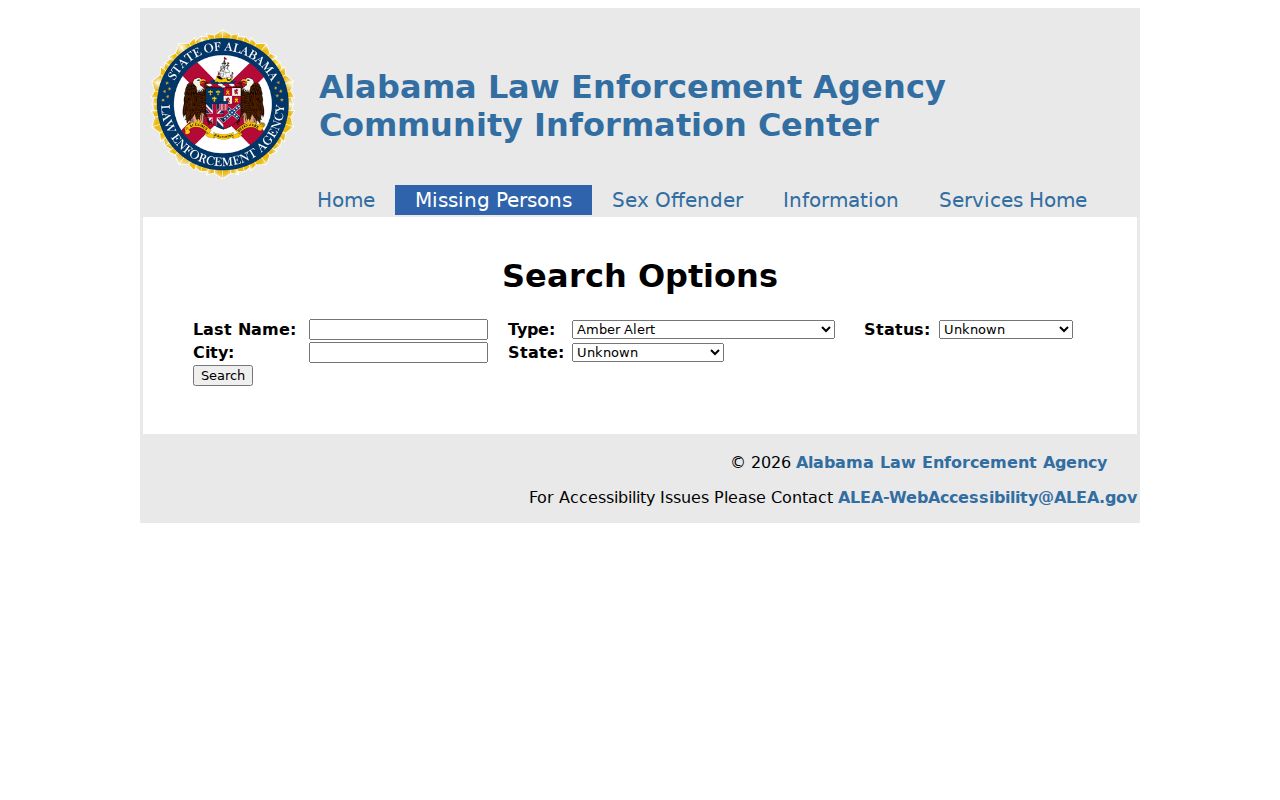
The form supports a Lawrence County registry search without sending readers to a commercial people-search service.
Alabama Sex Offender Registry Searches
The Alabama Sex Offender Registry is the first source for Lawrence County details because it receives data from the local registering agencies. It can show a local address and status that a broad national query may not put in the same context. The National Sex Offender Public Website, run by the U.S. Department of Justice, adds a cross-state layer. That matters when the person or address of concern may connect to another state.
The two tools serve different scopes. Use ALEA for the Alabama record and its statutory public fields. Use NSOPW to search participating jurisdictions across the country. A national result should still be checked against the public registry maintained by the jurisdiction that supplied it. No-match results also require care. Search spelling, aliases, geography, and agency reporting can affect what appears.
Lawrence County Registry and NSOPW
Cross-state checking is most useful when a move, past residence, or frequent travel makes a Lawrence County-only filter too narrow. Search the same name variants in both systems. Then open the source-jurisdiction record instead of relying on the result card alone. NSOPW brings public records from participating jurisdictions into one search layer, but each state remains responsible for its underlying information.
The Department of Justice NSOPW image source illustrates the national search route assigned to the Lawrence County offender lookup.
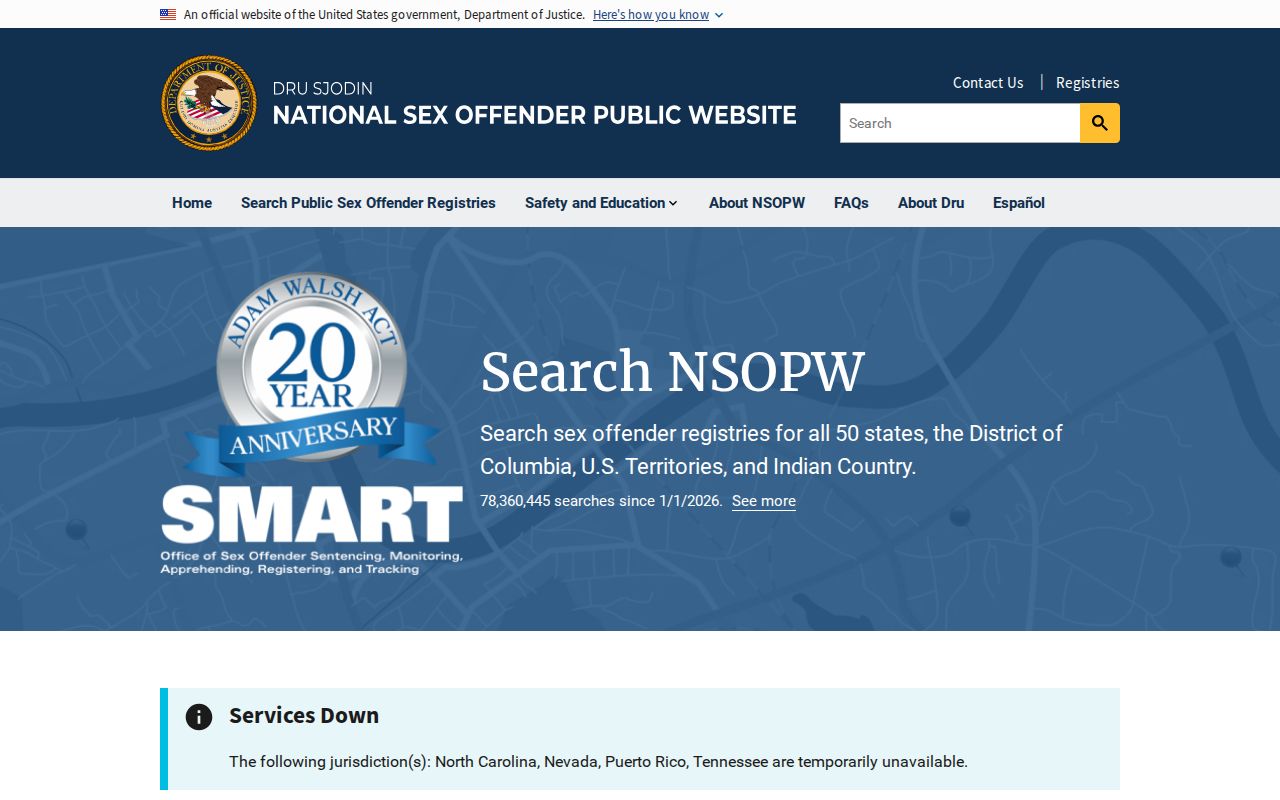
This second layer is helpful for range, while ALEA remains the direct source for an Alabama registry profile.
Registry Profiles: What They Show
Alabama Code § 15-20A-8 defines what ALEA must make public. The inventory is broader than a name and home address. It includes details meant to help a reader distinguish one record from another and understand the basis for registration. Some fields can involve school, work, and vehicles. Read each item as part of the same profile rather than treating one address or photo as the full record.
| Name and aliases | Legal name plus nicknames and ethnic or tribal names reported under the statute |
|---|---|
| Photo and description | Current image and physical description used to help distinguish identity |
| Reported locations | Each residence, school address, and employer address, including transient or day labor |
| Vehicles | License plate and description for reported land vehicles, aircraft, and watercraft |
| Offense history | Each covered adjudication or conviction and the text of the criminal provision |
| Registration status | Current reported status, including whether the registrant is listed as absconded |
Several sensitive items stay private: Social Security numbers, victim identity, travel or immigration document numbers, email and instant-message identifiers, Internet-service providers, and non-conviction arrest history. Those limits protect data that the public notice law does not authorize ALEA to display.
Lawrence County Registry Privacy Limits
Public access is specific, not unlimited. The registry exists to publish the fields Alabama law selects for community notice. It is not a full criminal-history repository. A Lawrence County registry profile therefore should not be read as a complete court docket, arrest history, or police report. For the filed case and outcome, the separate Lawrence County court case lookup is the relevant route.
This distinction prevents a common mistake. An offense listed on a profile explains the registration basis. It does not establish that the person has committed a recent offense, violated a current duty, or presents a known new threat. Status and address concerns require agency review. The public should not try to fill gaps by seeking protected identifiers or confronting the listed person.
Registration Levels and Duties in Alabama
Alabama does not use a simple adult Tier I, Tier II, and Tier III duration model. Adult full requirements generally involve lifetime duties and quarterly verification. Other categories depend on the adjudication, age, order, and statute. Importing a federal three-tier chart would misstate Alabama law, so the table uses the categories supported by the state research.
| Alabama category | Duration or relief | Verification |
|---|---|---|
| Adult full requirements | Generally life with full ASORCNA duties | Birth month and every three months thereafter |
| Registration-only adult category | Life; a later separate sex offense can trigger full duties | Birth month and quarterly thereafter |
| Juvenile lifetime order | Possible petition after 25 years under the stated release or sentencing rules | Quarterly |
| Juvenile ten-year order | Ten years, subject to the order and statute | Annually during birth month |
| Narrow age-gap, nonforce category | Possible petition-based relief if all statutory facts are met | Depends on the governing order |
Required changes involving residence, school, work or volunteer activity, and name generally must be reported within three business days. Homeless registrants report every seven days. Travel lasting three or more consecutive days requires advance in-person notice, while international travel generally requires 21 days of notice.
Lawrence County Registry Registration Office
The Lawrence County Sheriff's Office performs county sex-offender registration at 242 Parker Road in Moulton. The published main office number is (256) 974-2500. Exact registration counter hours and appointment steps were not posted, so call first. Within a municipality, the police chief is also a registering authority for a city resident.
Lawrence County Sheriff's Office
242 Parker Road
Moulton, AL 35650
(256) 974-2500
Call first for registration procedures.
Adult quarterly registration carries a $10 fee to each registering agency, and another $10 applies when a new residence is established with a new agency. Residence is generally barred within 2,000 feet of a school, child-care facility, or resident camp, measured in a straight line from property line to property line. A separate 2,000-foot rule concerns a former victim's or immediate family member's residence.
Lawrence County Registry Address Errors
An address that looks old may reflect a reporting problem, a move that has not been lawfully reported, or suspected noncompliance. Do not assume the database is simply stale. ALEA states that it posts information received from local law enforcement immediately and describes updates as daily or real time. Save the profile link, note the field at issue, and give the facts to the registering agency.
Call the Lawrence County Sheriff's Office at (256) 974-2500 for a county address concern. A city address may also warrant contact with that municipal police department. ALEA's CJIS and Sex Offender Registry contact is (334) 676-7700 or CJIS@alea.gov for system and correction routing. Do not visit the listed home, question neighbors, or contact the person named in the record.
The ALEA registry FAQ image source documents the public-listing and update rules used to assess Lawrence County profile concerns.
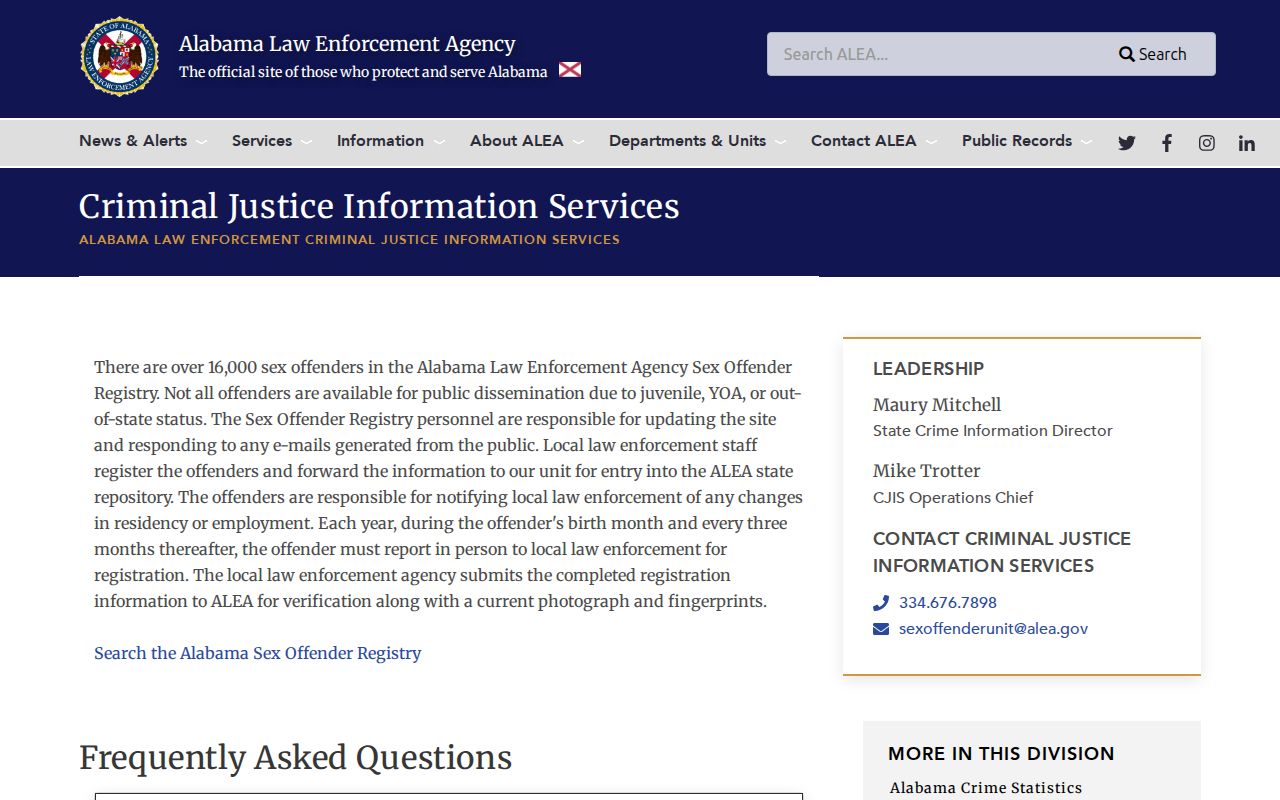
The FAQ supports agency reporting when a Lawrence County registry address or status appears inconsistent.
Using Registry Information Lawfully
Community notice may occur by mail, hand delivery, law-enforcement posting, newspaper, or electronic publication when allowed. The goal is awareness and sound safety planning. Registry information is supplementary. It is not proof of present dangerousness or a new crime, and the status of a listed person should not prompt threats, harassment, unlawful discrimination, or vigilantism.
Misuse can be criminal: Alabama research found no separate ASORCNA offense covering every misuse, but threats, harassment, assault, vigilantism, and unlawful conduct may violate ordinary criminal laws. Alabama Code § 41-9-601 also makes certain false-pretense acquisition or unauthorized communication of offender information felony conduct.
Report suspected noncompliance to the sheriff, municipal police, or ALEA. Give the agency a profile link, the disputed address or status, and the reason for concern. Let trained officers determine whether the record needs correction or whether a registration duty may have been violated. This approach protects the community without escalating risk.